Like many of the architect nomads who trot the globe, stamping urban landscapes with their signature buildings, I had known Renzo Piano from my beginning years at architecture school. I had read about his buildings and researched the philosophies that guided their designs. I had loved and admired most of them. I had even used a few as precedents during design studio projects. What always captivated me was the focus on space and light, and the innovative use of modern technology. Also the awareness and respect for context, physical and cultural always set his buildings apart. I would wonder how it all comes together. So when I entered the Renzo Piano Building Workshop studio in Genoa for the first time, it then dawned on me that I was about to get some answers. I would see it all coming together over the next six months. “This is where it all happens”. I thought.
What followed were introductions and briefings. I met Renzo himself that same day. His humility and humor struck me immediately, simultaenously. After a few greetings and introductions, he joked that he was not the boss in the office; that he only sweeps the floor.
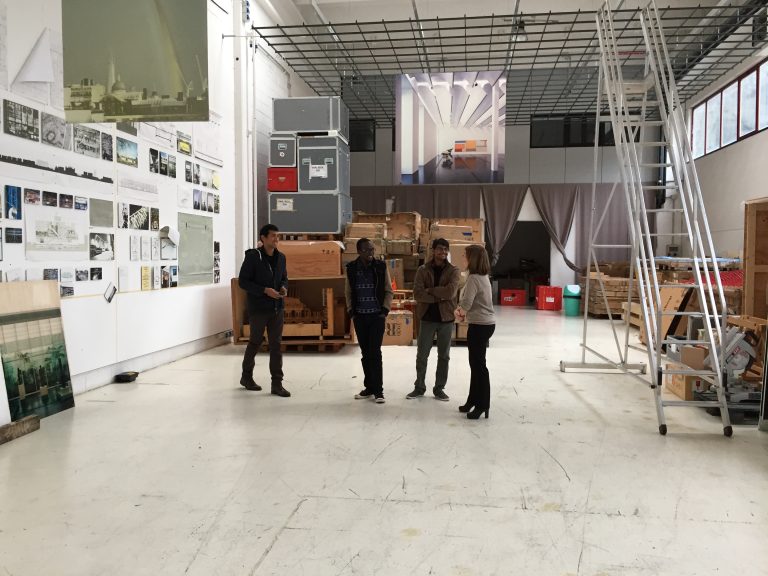
The office space overwhelmed me. Architectural drawings, renders, bas-reliefs, models are neatly pinned against the glass walls. Photos of current and past projects, complete or in-progress grace many walls, including in the kitchen. Some mock-ups are hung from the roof. On the entrance level a timber shelf runs a long wall, only punctuated by doors leading to other rooms. It is filled with a rich collection of books, monographs and journals on cross-cutting themes on architecture. There are planters at certain places within the building. There are few stone sculptures on the terraces and at the entrance, some being gifts to Renzo himself. The different floors of the building are stepped across the hill. People sit according to the projects they are working on, except for the administrators and Partners. Except for Renzo Piano. The top of shelves between work stations are littered with models, project documents and samples of materials. For a student architect like myself, this place looked like paradise.
My desk was on the lowest level, which meant I enjoyed very imperial views of the Ligurian sea downhill, through the glass façade of the office building. To my immediate right was the model shop which would turn out to the place where I would spend a lot of my time during office hours. It was not like any other model shop I had worked in before. All sorts of machines and tools were at my disposal. Some I had used before, many I had not even seen. There are 3D printers, laser cutters, foam cutters. There are cabinets with all manner of tools. On top of the tables in the model shop are models being worked on. So neat. So precise. So incomplete. World class! I was blown away. I knew I would have a lot of learning to do, and fast.
The studio work
I was one of four interns in the office at that time. Over the course of my time there, I worked on 3 projects, always as part of a team of 4-5 other architects and one supervising RPBW Partner. Interestingly all the projects were at different stages at the time when I would get involved. As result I was able to engage at different phases in the design process.
The One Sydney Harbour project was at the stage of development application where designs are being revised and updated as dictated by many factors. In an article in the Wall Street Journal, Renzo listed a model I made for this project as one of his favorite things. The Istanbul Modern museum was at the concept design and schematics stage so I got the opportunity to see how it all starts and how the underlying ideas are translated into the design and developed further. I learnt that there is never a singular magic-wand solution to any design challenge. Only by studying the problem in detail using various techniques can you come up with something desirable and deliverable. For the Whittle School and Studios in the Schenzhen, I got the opportunity to see how a prototype design can be adapted to a real site without compromising the initial concepts. Its never so easy.
Learning by travelling
I travelled to several places and experienced several locales within Italy. From major metropolises to tiny villages, from small port cities along the Mediterranean coastline to towns high up in the Alps; I learnt more through this journeys than I would ever by reading.
Now let me share with you some excerpts from my travel diary to select places I visited.
Genova: I didn’t visit Genova. I lived and worked there. Italy commands a long Mediterranean coastline and Genova is its biggest port city. It’s also the capital of the region of Liguria, and quite significantly Renzo Piano’s birthplace. Here you can see one of Renzo’s earlier projects, the Porto Antico. This was a vast exhibition project that later became an urban renewal plan. There are a few other architectural landmarks like the Cathedral of St. Lorenzo.
The eternal city and the Vatican: Based on my previous knowledge and readings about Rome, I expected my trip there to be an architectural, historical and artistic visual feast. Rome met and exceeded that expectation! The visit to the Vatican even added another dimension, almost turning it into a pilgrimage. I roamed in Rome. In ancient Rome it was like travelling back in time as I walked through the ruins of the Roman and Imperial Forums, by-passing ruins of Temples, Arches, Basilicas, and Columns; soaking myself in their millenary history. It’s a lot of information to process in a short time. You can only admire, take a picture and proceed. I entered the Colloseum, where centuries ago many gladiators and wild beasts lost their lives in for the sake of the power of Rome. The Pantheon, the Catacombe tombs, the Palatine Hill and Circus Maximus, the Spanish Steps were among other places of architectural interest that I visited. The Vatican museum, the Sistine chapel, the St. Peter’s Basilica interested me inside Vatican city. I climbed to the top of the St. Peter’s Basilica, entered the Sistine chapel and spent time inside the colossal Vatican museum with its splendid collectons of art assembled by various Popes. I took pictures with the papal guards in their beautiful costumes.
Design after design. The Milan design week: For a week in April, Milan became the international reference point for furniture and product design. Featuring thousands of exhibits, the city was remarkably enlivened by this event.
Attributed as the the fashion capital of Europe, Milan can appear trendy and elegant and high-end. Some people appear to be showing off with their expensive designer attires. I am just saying. As an architecture student, I was more fascinated by the flows in the city, the different mode of transportation and the interchanges. Its interesting to observe how people (lots of people) get from one place to another, in an orderly manner. The metro system confused me the first time. On the street I would stand and observe how the tram and the vehicles move on the same road without colliding. Amazing!
Reporting from the front: The Venice architecture biennale. Two main reasons took me to the sinking city of the canals. I wanted to experience the architecture biennale for the first time, and then to prove if Venice is indeed the city described by Italo Calvino in the book ‘Invisible Cities’. I am not yet convinced about the latter. But the city of love, the consummate magician had more magic in store for me. The network of canals that snake through the city give it its vibe. Everything else revolves around this. The experience of travelling around in the taxi-boats and watching the buildings ‘float’ in water is unparalled. Boats are even used as ambulances.
The biennale was a place to observe, learn and get inspired on diverse issues and approaches to art and architecture. The story of every project is unique and inspiring. I liked our own exhibiton as RPBW, but one project, ‘From Border to Home’ really touched me. It touched on current sensitive isues regarding the flow of refugees into Europe, their plight, and he failure of European solidarity to address this issue. It didn’t only highlight the problem, it offered a few interesting interventions.
The birthplace of the Rennaisance. Like Rome or Venice, Florence gets photographed a lot. Its very touristic. The new and the old city are separated by a river. The Rennaissance style was developed first here with Filippo Brunellesschi as one of its innovators before quickly spreading to other Italian cities, and then across Europe. There is not a better place to study the characteristics of this style than in Florence. The emphasis on symmetry, proportion, geometry, and the regularity of parts are not difficult on notice on famous buildings like the Basilica di San Lorenzo, the Duomo in Florence or the Palazzo Rucellai.
My second visit to Florence came as part of an office trip to the Chiesa de Autostrada (Church on the street), and the Marchesi Antinori winery.
Hiking in the Alps. I visited Bolzano and Merano Meran, close to the border with Austria. This place was originally in Austria and it has a big German speaking population. Large portions of the landscape here is agrarian and insanely beautiful.
The floating piers at Lake Iseo: For three weeks in June the Christo and Jean-Claude site specific art work was on display at Lake Iseo which is about 2 hours by train from Milan. The art work consisted of 100,000 square meters of yellow fabric, carried by a modular floating dock system of 220000 high desity polyethylene cubes. It attracts thousands of tourists and visitors over the time it is on display. I visited the project together with a group of my friends who are students at Polytechnico di Milano.
The Muse and ‘Le Albere’. We visited this project as part of the interns’ day on site. The mixed use project comprises of commercial and residential buildings, a multipurpose building and the Muse – a large, interactive science museum that acts as the project’s magnet. As described in the RPBW website, “this urban renewal project has reconnected the city to its natural context which in Trento is defined by the River Adige and Monte Bondone. This new distict, for a long time physically separated from the city center by the railway now feels psychologically closer”. Construction was nearly complete for all the buildings but the time we spent on the active building site here was still rewarding.
On Italian cities
All Italian cities are beautiful but some are more beautiful than others. They all appeal to you in specific ways. Milan blew my mind away. Rome touched my spirit. Venice stole my heart. They are all different, spatially and in terms of the functions they are famous for. You can easily see that these differences are being celebrated, and pronounced, and not suppressed. Rome is not trying to be Turin, or even worse to copy New York or Dubai. Its proud to be Rome. In many urban areas back home I find the problem of copying so rampant, resulting in severe lack of character or distinctions in urban life. Alexander Christopher writes in the Pattern Language that, “our societies perish because of a lack of character, a lack of uniqueness.”
In spite of these unique appeals, I observed that there are still a sense of commonality that integrate these cities to general Italian way of life, especially through the lens of urban planning and design. It’s the features like the piazzas and the narrow, stone paved pedestrian stradas that are flanked by shops, cafes, bars and restaurants. You may feel closeted in them but you cannot fail to appreciate how important they are to people: young or old, tourist or native, immigrant or refugee. Some use these spaces in solitude. Others communally to meet and do life, earn their livelihoods, or even to celebrate or cry, depending on whether the Azzuri have won or lost a soccer match respectively.
On Architect Renzo Piano
The concept of master and apprentice has strong roots in many cultures. In ancient Japanese culture an apprentice was introduced to a master of a particular trade. The role of the apprentice was to assist the master and in the process pick up lessons and skills. The master would not particularly sit down to teach the apprentice anything. But by being involved the apprentice would pick up these lessons. I can relate my time at RPBW and my interractions with Renzo Piano to the understanding of this relationship.
Perhaps the greatest things that I have learnt from here is not the techniques of sketching or model making or drawings. Of course I improved in search skills, but it’s the intangible ones like confidence to undertake a design process that I would cherish the most. It comes from immersing yourself in that atmosphere, from being a part of it all. I became accustomed to the sounds of the different machines in the model shop, the fight to beat deadlines with all the frustrations and anxiety it brings. Sometimes there were heated discussions during meetings or during conference calls. It wasn’t a smooth ride everytime. But it was worth it.
During the interns’ final meeting with Renzo, he asked about what we had learnt, the experiences and the particular things that we would take back from the training. He advised against falling in traps of ‘architecture machines’, referring to extremely large firms where one undertakes only a very specialized task. He said if he were a young architect now he would rather work in a smaller office and get more involved than be in a very big office without any good involvement.
He said that “architecture is a social art, that you have to be in an atmosphere where you can see other people do interesting things then learn form them”. “Creativity is contagious” he added. Andreas Dracopoulos who worked closely with Renzo on the project of the Stavros Niarchos Foundation cultural center in Athens says “Renzo exudes the respect, intergrity and humility of a master craftsman in complete complete control of his art”. I cannot agree more. He is a true master whose skills have been refined by years of practice. The 1998 Pritzker jury compared Renzo to Leonardo Da Vinci, Michelangelo and Brunelleschi explaining that “his intellectual curiosity and problem-solving techniques are as broad and wide ranging as those of the earlier masters from his native land”. I agree entirely. He is one of the greatest alive.
Conclusion
A lot of things changed during the time I was at RPBW and in Italy, including the seasons. I saw winter melt into the fragrant spring before the summer heat became intense. In summer the sea changed into my big ‘swimming pool’. One thing though didn’t change. The attitude of the people with whom I worked. They are some of the most talented and world-class group of architects you can ever find in the same place, everyone helping each other out; testing, collaborating and inventing together. Its like a family. I will remember all those moments shared with all of them, in office, at house parties, barbecues, birthday celebrations, soccer matches and during trips. I already miss everyone and everything, apart from sea food. I am not even planning it miss any sea food, especially octopus.
By Benard Acellam